The pathway was meant to be straightforward. The incident, whatever it was — the bicycle accident, the rugby collision, the skiing fall, the unfortunate slip on a wet floor — produced a concussion, the symptoms were managed acutely, and the patient was told that recovery typically takes a few weeks. For the majority of patients with mild traumatic brain injury, this is broadly accurate. Symptoms resolve, function returns, and life continues.
For a meaningful minority — current estimates range from 10 to 20 percent of mild TBI patients depending on the population studied — the recovery does not follow that course. Symptoms persist past the expected resolution window. Cognitive function does not fully return. Sleep remains disrupted. Headaches recur with a frequency and severity that interfere with work and daily life. Sensitivity to light, noise, and screens persists in ways that the patient learns to manage but does not, in any honest assessment, recover from.
This is post-concussion syndrome, and it is one of the more under-treated conditions in adult medicine. The standard sports medicine pathway is well-developed for acute concussion management. It is much less well-developed for the patients whose symptoms persist past the acute window, and these are the patients who increasingly find their way to Holina Clinic looking for an alternative.
What Is Actually Producing Persistent Symptoms
HBOT for persistent post-concussion symptoms has substantial peer-reviewed support. A 2022 study in Frontiers in Neurology documented significant improvements in cognitive function, sleep, and quality-of-life measures in chronic post-concussion patients following a 40-session HBOT course at 1.5 ATA, with effects sustaining at follow-up.
The clinical mechanisms underlying post-concussion syndrome are increasingly well-characterised. Persistent neuroinflammation in the affected brain regions, with documented elevation of inflammatory markers months and sometimes years after the original injury. Mitochondrial dysfunction in neural tissue, reducing the cellular energy available for normal cognitive and autonomic function. Disrupted cerebral blood flow patterns, with affected regions showing reduced perfusion on advanced imaging. Autonomic dysregulation, often presenting as exercise intolerance, postural symptoms, and sleep architecture disruption. Vestibular and oculomotor system involvement that the acute care setting did not adequately assess or treat.
These mechanisms are not detected by standard imaging. CT and conventional MRI typically appear normal in post-concussion syndrome, which is one of the reasons patients in this category are frequently told that there is nothing wrong despite their continuing symptoms. Advanced imaging modalities — diffusion tensor imaging, functional MRI, SPECT scanning — show the abnormalities clearly, but these are not routinely available in standard pathways.
Why Standard Care Is Often Insufficient
The standard care for post-concussion syndrome in most healthcare systems consists of rest, symptomatic medications for headache and sleep, and a graded return to activity. For acute injuries, this is appropriate. For chronic post-concussion syndrome, it is rarely sufficient. The interventions are not addressing the underlying mechanisms — the inflammation, the mitochondrial dysfunction, the perfusion deficits — that are sustaining the symptoms.
What does address these mechanisms, with a substantial and growing evidence base, is hyperbaric oxygen therapy.
The HBOT Evidence Base for Post-Concussion Syndrome
The peer-reviewed literature on HBOT for post-concussion syndrome has expanded considerably over the past decade. Multiple randomised controlled trials and large cohort studies have documented measurable improvements in cognitive function, headache frequency and severity, sleep quality, and quality-of-life measures following structured HBOT protocols in chronic post-concussion patients.
The mechanism is consistent with the clinical findings. HBOT reduces neuroinflammation, supports mitochondrial function, improves cerebral perfusion both acutely and durably over a treatment course, and supports the brain’s repair processes through stem cell mobilisation and angiogenesis. In aggregate, these effects address the substrate that has been sustaining the symptoms.
The clinical results, in the patients we have worked with at Holina Clinic, have been substantial. Cognitive symptoms typically improve significantly within the first 15 to 20 sessions. Headache patterns reduce in frequency and severity over the course. Sleep architecture begins to normalise. Exercise tolerance returns. The patient who arrived with a constellation of persistent symptoms typically leaves the course with most of those symptoms either resolved or substantially reduced.
What the Treatment Course Looks Like
A Holina Clinic post-concussion protocol typically begins with detailed assessment, including cognitive testing, autonomic assessment, vestibular screening, and where indicated, advanced imaging or laboratory workup. The protocol is then calibrated to the specific picture each patient presents with.
For post-concussion syndrome specifically, we typically run 40 sessions at 1.5 to 2.0 ATA, delivered over eight to ten weeks. The longer course reflects the chronic nature of the condition and the need for the underlying mechanisms to fully respond rather than partially improve. Some patients benefit from additional sessions beyond this baseline, and we adjust the protocol based on assessed response.
Alongside the HBOT, supporting interventions are commonly indicated. NAD+ infusion therapy supports mitochondrial recovery. Targeted micronutrient correction addresses deficiencies that frequently accompany the post-injury picture. Carefully calibrated exercise rehabilitation, including vestibular and autonomic work, supports return to full activity. Sleep optimisation is addressed directly, because sleep itself is one of the substrate processes through which the brain repairs.
Who This Protocol Is Appropriate For
Adults with mild traumatic brain injury whose symptoms have persisted past six weeks. Patients in the chronic post-concussion category, sometimes years after the original injury, who have not had access to HBOT-based protocols. Athletes returning from sport-related concussion who have not achieved full pre-injury function despite completing standard return-to-play protocols. Patients with multiple concussions over the course of a sporting or military career whose cumulative effect is more pronounced than any single event would produce.
The protocol is less appropriate for severe traumatic brain injury in the acute phase, where higher-acuity neurological and neurosurgical care is required, and for patients with active middle ear pathology or untreated pulmonary disease that would contraindicate pressurised oxygen delivery. These factors are assessed in pre-treatment evaluation.
The Setting at Holina Clinic
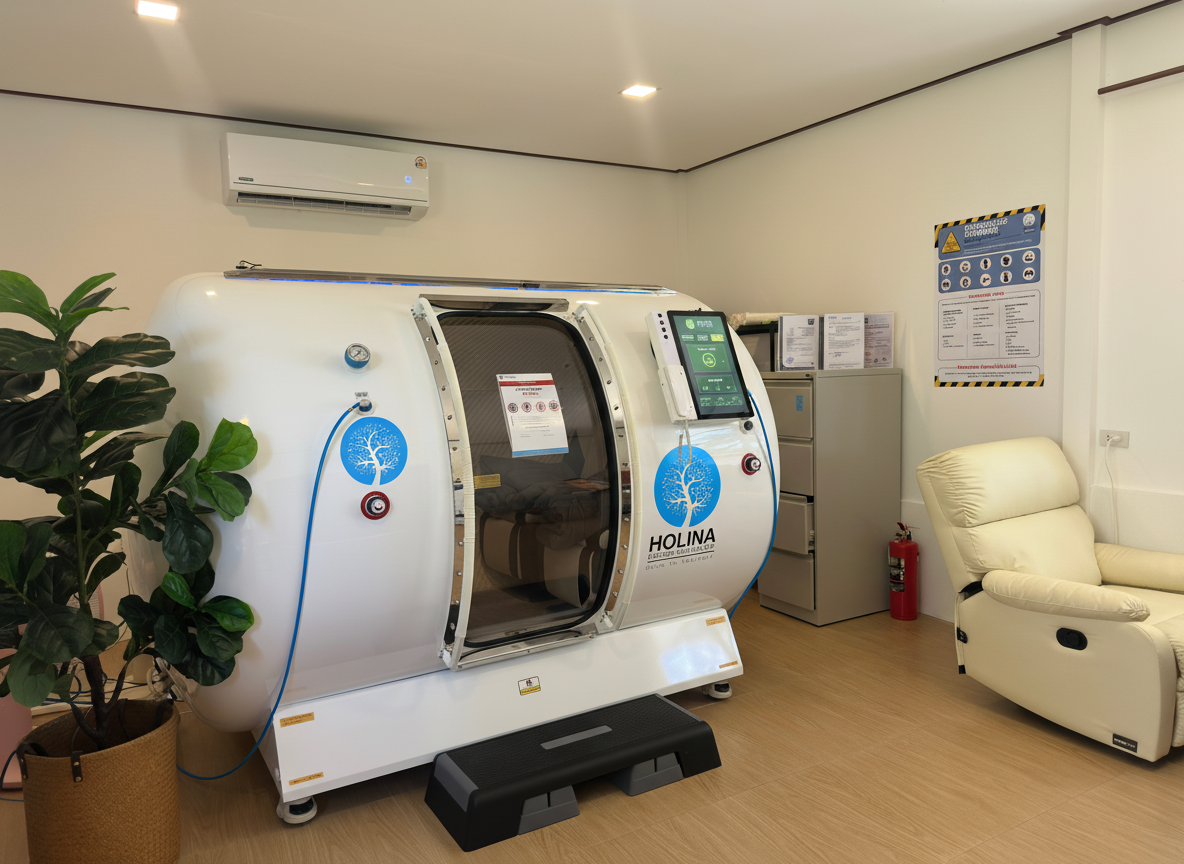
The clinic is currently based on the Holina campus, with full clinical infrastructure for the protocols described in this piece. Patients undergoing residential HBOT courses at Holina Clinic typically stay with us through the active treatment phase, which allows for the integrated supporting interventions, the appropriate pacing, and the supportive environment that the recovery itself benefits from. The post-injury brain heals better in calm, clean, structured environments than in the chaotic settings most patients have been managing the condition within.
A Closing Note
If you have been living with post-concussion symptoms past the point at which you were promised they would resolve, the condition is not in your imagination, and the pathway you have been offered is not the only pathway available. The work that addresses the underlying mechanisms exists, has substantial evidence, and produces measurable clinical results. The first conversation with our team is the beginning of finding out whether the protocol we offer is appropriate for your specific picture.