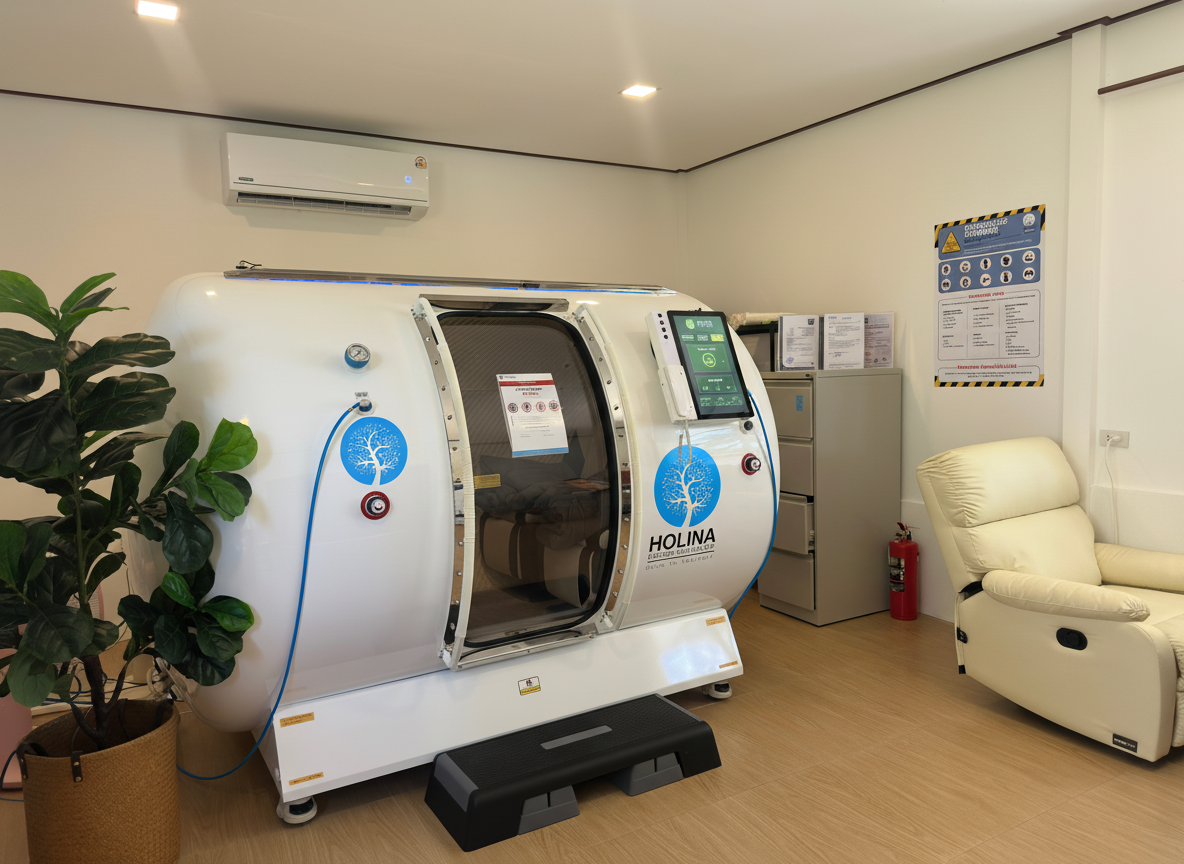
The elite swimmer surfaces from her final lap, her shoulders still burning despite the ice bath and compression sleeves waiting poolside. It is 6 a.m. in Bangkok, and she has trained for three hours. Her coach notes the slight asymmetry in her stroke, the fractional loss of power on her left side. Micro-tears in the rotator cuff, perhaps, or simply accumulated oxidative stress from six weeks of twice-daily training camps. She has forty-eight hours before nationals. The conventional options feel hollow: rest days she cannot afford, NSAIDs that dull her sharpness, cortisone injections that offer false recovery. Instead, she descends into a pressurised chamber. For ninety minutes, breathing pure oxygen at 2.8 atmospheres, her body enters a physiological state her training cannot replicate. The fatigue she feels is real. The solution, however, belongs to a category of medicine most elite athletes have never seriously considered.
What this athlete experiences is not unique to swimming. Across elite sport, there exists a persistent gap between the intensity of training demand and the body’s capacity to recover fully between sessions. This gap creates a clinical reality: high-performing athletes accumulate tissue injury, inflammatory burden, and neuromuscular fatigue that standard recovery modalities, whilst evidence-based, do not fully address. Hyperbaric oxygen therapy, or HBOT, represents a physiological intervention grounded in cellular biology rather than ergogenic speculation. It is not a shortcut; it is a tool for optimising the body’s own repair mechanisms when those mechanisms are overwhelmed by training load.
This piece is for elite athletes, sports medicine practitioners, and performance-focused individuals who recognise that recovery is not passive but a skilled, measurable component of athletic development.
What This Is, Specifically
Hyperbaric oxygen therapy delivers 100% oxygen at pressures greater than 1 atmosphere absolute, typically between 2.4 and 3.0 atmospheres, for sessions lasting 60 to 120 minutes. The mechanism operates at multiple biological levels. Elevated pressure increases the dissolved oxygen in blood plasma independently of haemoglobin, allowing oxygen delivery to tissues with compromised microcirculation, including recently injured muscle and tendon. This hyperoxia also stimulates mitochondrial biogenesis and enhances the expression of vascular endothelial growth factor, promoting angiogenesis and improving tissue perfusion during recovery windows.
The clinical evidence for HBOT in sports recovery is differentiated. Lancet-published research on acute soft tissue injuries demonstrates that HBOT accelerates wound healing and reduces inflammatory markers when applied within 72 hours of injury. A 2019 systematic review in the British Medical Journal identified high-quality evidence for HBOT in diabetic foot ulcers and radiation injury; evidence in sports-specific contexts remains more limited but mechanistically sound.
The distinction matters. HBOT is not a performance-enhancing substance; it operates within the body’s own oxygen homeostasis and repair capacity. Unlike corticosteroids or NSAIDs, which suppress inflammation and carry metabolic cost, HBOT amplifies the physiological systems already engaged in repair. For athletes recovering from acute muscle strain, tendon microtears, or delayed-onset inflammation after high-volume training blocks, the cellular rationale is robust: increased oxygen availability accelerates ATP regeneration in mitochondria, supports collagen cross-linking, and enhances clearance of metabolic byproducts that perpetuate soreness and functional deficit.
Why Standard Treatment Often Misses This
Elite sport operates within a compressed timeline. An athlete has perhaps forty-eight to seventy-two hours between competing stimuli. During this window, conventional recovery, which serves the general population well, encounters a bottleneck. The injured tissue requires oxygen, anti-inflammatory signalling, and angiogenesis. Standard care offers rest, non-steroidal anti-inflammatory medication, and manual therapy. These are evidence-based. But they are passive interventions, and they do not address the fundamental constraint: if microcirculation is disrupted by swelling or fibrosis, oxygen cannot reach the site of injury efficiently regardless of how much systemic oxygen is available.
Sports medicine has historically privileged biomechanical assessment and load management, which are essential. Yet it has underutilised interventions that enhance the tissue’s capacity to tolerate load. HBOT sits in this gap. It is neither controversial nor ergogenic, yet it remains peripheral in most elite sports recovery protocols, partly because the evidence base, whilst mechanistically strong, does not match the volume of research on more conventional modalities. Additionally, accessibility has been limited; hyperbaric chambers are expensive and require clinical infrastructure. This has meant that HBOT has remained largely confined to acute injury management in hospital settings rather than being integrated into planned recovery schedules for elite athletes.
The result is that an athlete experiences what might be termed “incomplete recovery”: tissue healing occurs, but microvascular function and oxidative capacity remain suboptimal, perpetuating subtle performance deficits and heightening injury recurrence risk across a season.
Cellular Repair and Mitochondrial Response
The depth of HBOT’s mechanism reveals why timing and consistency matter. When muscle undergoes intense contraction, it generates reactive oxygen species as a byproduct of energy metabolism. Paradoxically, controlled hyperoxia can augment the body’s antioxidant defence systems, including upregulation of superoxide dismutase and catalase expression. This is distinct from acute oxidative stress; it represents a hormetic stimulus that primes cellular resilience.
At the mitochondrial level, increased oxygen availability accelerates the electron transport chain and enhances ATP production per cycle, meaning damaged muscle and tendon can mount a more robust synthetic response during healing phases. Research presented at sports medicine conferences has documented that athletes undergoing HBOT during recovery blocks show faster normalisation of creatine kinase levels and reduced delayed-onset muscle soreness when measured objectively.
Equally relevant is the effect on angiogenesis. Hyperbaric conditions stimulate vascular endothelial growth factor signalling, promoting the formation of new capillary networks in recently injured tissue. For an athlete, this translates to restored blood flow capacity and faster oxygen delivery to working muscle during subsequent training sessions. The tissue does not merely heal; it heals with enhanced functional capacity.
The timeline is clinically meaningful. A single HBOT session produces acute effects on oxygen delivery and mitochondrial respiration. A series of ten to fifteen sessions over two to three weeks produces more durable changes in angiogenesis and collagen remodelling, suggesting that integration into planned recovery blocks is more rational than ad-hoc application.
What a Residential Period Provides
HBOT at Holina Clinic is embedded within a broader residential recovery framework. This distinction is crucial. A single HBOT session in isolation offers acute physiological benefit; a structured residential programme combining HBOT with systematic load management, nutritional optimisation, sleep architecture enhancement, and manual therapy creates cumulative effect.
The residential format permits consistency. An athlete receives daily sessions in a clinical environment where pressure protocols are individualised, monitoring is continuous, and integration with other recovery modalities is deliberate. Crucially, the residential setting removes the athlete from the training environment, interrupting the cycle of accumulated fatigue and allowing genuine recovery windows to emerge.
The programme also permits assessment. Objective markers including inflammatory cytokines, oxidative stress markers, and functional capacity testing can be measured before, during, and after the residential period, providing evidence of physiological change rather than relying on subjective improvement alone.
For elite athletes operating at the margins of performance, where marginal gains accumulate, this structured integration of HBOT within a comprehensive recovery environment addresses not only acute injury but the deeper problem of incomplete recovery from training load. The duration typically spans two to four weeks, depending on the athlete’s specific needs and competition calendar.