“`html
It is 3 p.m. in a Bangkok apartment, and the woman sitting by the window has not left in six months. Her name is Priya. Eighteen months ago, she had COVID-19, a mild case by all standard measures. She recovered from fever and respiratory symptoms within two weeks. But something did not resolve. The fatigue that followed was not the tiredness of convalescence; it was neurological, crushing, accompanied by a peculiar inability to concentrate that her colleagues called “brain fog” before she stopped attending meetings altogether. Her heart rate climbs when she stands. Pain migrates through her joints and muscles without obvious inflammation. Her sleep is fractured. Three different doctors have run standard bloods, found nothing remarkable, and suggested she return to work. One mentioned depression. Another recommended graded exercise therapy. She has tried both. She is worse. Now she sits by the window, watching other people move through their lives, wondering if she has simply become a different kind of person, one for whom the ordinary world is no longer accessible.
Priya’s experience is neither rare nor new, yet it remains systematically misrecognised and under-treated across most healthcare systems. Long COVID, now formally designated as Post-COVID-19 Condition by the World Health Organisation, affects millions of patients globally who have not recovered to baseline health after SARS-CoV-2 infection. The condition spans multiple organ systems, defies standard laboratory markers, and does not respond predictably to conventional treatment protocols designed for acute viral illness or discrete single-system disease. This complexity creates a profound clinical gap: patients are often discharged with reassurance and standard advice, only to discover months or years later that they remain significantly impaired. The severity of this gap is now recognised in major clinical literature, yet access to comprehensive, evidence-informed rehabilitation remains scarce in most regions, including Asia-Pacific.
This piece is for long COVID patients who remain unwell despite standard medical investigation and initial treatment, and for those seeking a more sophisticated, multi-system approach to recovery in a centre equipped for residential, integrated care.
What This Is, Specifically
Post-COVID-19 Condition, as defined by the World Health Organisation, is characterised by persistent or new-onset symptoms that emerge during or after confirmed SARS-CoV-2 infection, lasting at least 8 weeks, and not attributable to an alternative diagnosis. Symptoms frequently include profound fatigue unproportionate to exertion, post-exertional malaise (acute deterioration following minor physical or cognitive effort), cognitive impairment, breathlessness, chest pain, and dysautonomia (dysfunction of the autonomic nervous system).
The Lancet Commission on Long COVID (2021) reported that approximately 10 per cent of COVID-19 patients develop long COVID, with many unable to return to baseline functional capacity at 12 months post-infection. Symptom severity varies from mild impairment to complete disability. Immune dysregulation, persistent viral antigen, mitochondrial dysfunction, and microclot formation have all been identified as potential pathophysiological mechanisms in peer-reviewed studies, though no single mechanism accounts for all cases. BMJ Open research has documented significant disability, reduced quality of life, and high rates of psychiatric comorbidity in long COVID cohorts, partly due to prolonged isolation and medical invalidation. The condition is now recognised by NICE (UK), the CDC (USA), and most major health systems as a legitimate clinical entity requiring specialist assessment and multi-modal treatment.
Why Standard Treatment Often Misses This
Conventional medical training and infrastructure are organised around diagnostic clarity: a pathogen is identified, a drug targets it, symptoms resolve. Long COVID violates this paradigm. Standard blood tests and imaging often appear normal, which unconsciously signals to clinicians that the patient’s symptoms are functional or psychological rather than biological. This represents a critical conceptual error. Absence of abnormality on routine testing does not mean absence of pathology; it often simply reflects the limitations of the test. Many long COVID patients have been inadvertently harmed by well-intentioned graded exercise therapy (GET) designed for deconditioning, when in fact they have post-exertional malaise, a condition in which exertion triggers disproportionate, delayed symptom flares lasting days or weeks. This distinction is clinically fundamental and yet frequently missed in standard rehabilitation models.
Second, most acute-care hospital systems are not designed for chronic, multi-system rehabilitation. Long COVID patients require sustained assessment across neurology, immunology, autonomic function, pulmonology, and psychiatry, integrated into a coherent treatment programme, often over weeks or months. General practitioners and standard outpatient clinics lack the infrastructure, time, and clinical cross-disciplinary knowledge to deliver this. Third, environmental and psychological factors compound the problem: medical invalidation and repeated reassurance that “nothing is wrong” often induces iatrogenic harm, deepening hopelessness and deconditioning. Patients are discharged prematurely and left to manage complex symptoms in isolation. By the time many seek specialist care, they have developed secondary complications including severe deconditioning, isolation-related psychiatric symptoms, and maladaptive coping patterns that require therapeutic unpicking.
Autonomic Dysfunction and Mitochondrial Impairment: The Central Mechanisms
Two mechanisms appear repeatedly in long COVID research and explain why standard treatments often fail. The first is autonomic nervous system (ANS) dysfunction, particularly dysautonomia presenting as orthostatic intolerance, abnormal heart rate variability, and blood pressure dysregulation. Frontiers in Medicine has documented abnormal tilt-table test responses and reduced cardiac parasympathetic tone in long COVID cohorts. This explains why standing, moving, or even thinking can trigger disproportionate symptoms: the autonomic nervous system has lost its capacity to smoothly regulate cardiovascular and neurological demands. Conventional cardiology workup misses this because resting ECG and echocardiography are normal; the problem emerges only during physiological stress.
The second mechanism involves mitochondrial and metabolic impairment. Mitochondria are the cellular power plants; if they are not functioning optimally, even ordinary activity depletes cellular energy reserves, triggering the profound fatigue and post-exertional malaise observed in long COVID. This is not deconditioning in the classical sense; it is a metabolic constraint that graded exercise paradoxically worsens. Treatment must therefore focus on metabolic support, gentle rehabilitation tailored to individual autonomic limits, and therapies that promote mitochondrial and immune recovery. This requires ongoing physiological monitoring and personalised adjustment, not standardised protocols.
What a Residential Clinical Programme Offers
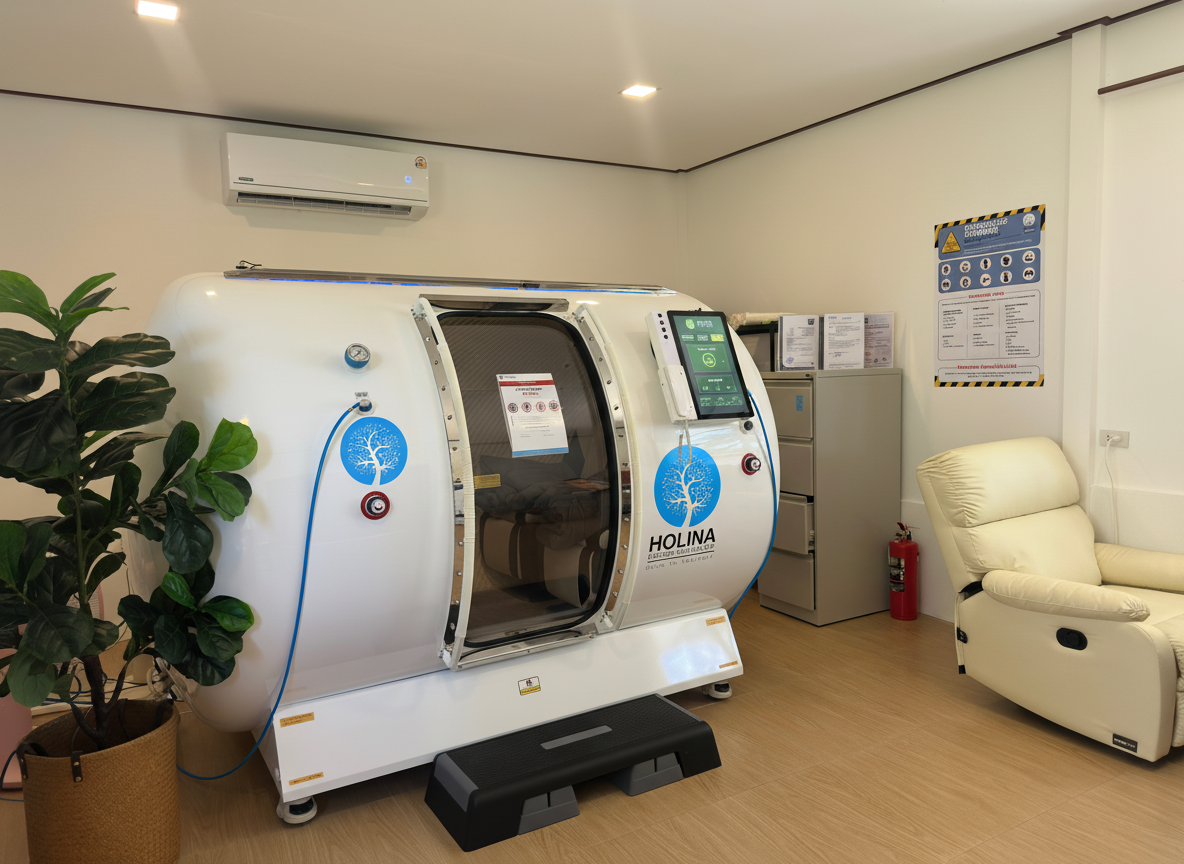
A comprehensive residential programme for long COVID operates fundamentally differently from standard outpatient care. It provides daily multi-disciplinary assessment across autonomic physiology, immunology, cognitive rehabilitation, structured movement therapy, and psychiatric support. Rather than a single diagnosis and a single treatment, it builds a detailed physiological map of each patient’s unique presentation and delivers personalised interventions adjusted in real time based on response. This might include autonomic retraining, careful graded activity prescription that respects post-exertional malaise thresholds, nutritional and metabolic support, immune modulation, and psychological support for the secondary trauma of prolonged illness. Therapies such as HBOT at Holina Clinic can be integrated where indicated for patients with evidence of hypoxia or mitochondrial stress. The residential environment itself provides containment, removes the burden of daily self-management, and creates space for meaningful recovery work. Most importantly, the extended stay allows sufficient time for the nervous system to recalibrate and for genuine, sustainable improvement to take root, rather than a premature discharge followed by relapse.
“`