Marcus sits in his glass-walled office on the thirty-fourth floor, the Bangkok skyline dissolving into haze beyond the windows. He has forgotten the name of a colleague he met three times last month. His emails require two drafts where one sufficed five years ago. At forty-two, he attributes this to stress, to too many late nights, to the ambient chaos of running a regional division. His doctor ran routine bloods. Everything normal. Yet the fog persists, thickening. He cancels his evening run, too fatigued to change clothes. In the mirror, he recognises himself but wonders if his mind will keep pace with the reflection. This is not normal ageing. This is the threshold moment, the point at which subtle neurological decline becomes measurable, the window in which intervention moves from optional to urgent. Marcus is not alone. Across Bangkok’s business districts and residential enclaves, thousands occupy this liminal space, aware enough to worry but not yet impaired enough to seek help.
The phenomenon Marcus experiences sits at the intersection of neuroscience, occupational medicine, and preventive gerontology. Cognitive decline in middle age, once dismissed as benign forgetfulness or stress-related fatigue, is now recognised as a measurable precursor to more significant neurodegenerative conditions. This pattern emerges across multiple cohorts: those in cognitively demanding professions, individuals under sustained stress, people with unoptimised sleep or metabolic health, and those whose physical activity has contracted with age. The clinical literature increasingly positions the decade from forty to fifty as a critical period for intervention, one where the trajectory of later-life cognition is substantially shaped by modifiable factors.
This piece is for high-performing professionals in their 40s who recognise subtle shifts in memory, processing speed, or mental clarity, and for those who recognise that waiting for a formal diagnosis may mean missing the window of meaningful prevention.
What This Is, Specifically
Cognitive decline in middle age encompasses measurable losses across executive function, processing speed, and episodic memory that exceed normal age-related variation and precede formal dementia. The Lancet Commission on Dementia Prevention, Intervention, and Care identifies the period from age forty onwards as critical for modifiable risk factor management. Rather than a disease state, this often represents a confluence of metabolic, vascular, sleep, and inflammatory factors acting upon genetically variable cognitive reserve.
The World Health Organisation characterises cognitive impairment as a spectrum rather than a binary state. Subjective cognitive decline, where individuals report genuine functional change whilst standardised tests may appear normal, represents an early marker. Research from the journal Neurology demonstrates that individuals reporting memory or processing concerns in their 40s show measurable grey matter changes and altered biomarkers compared to those without complaints, even when conventional testing appears unremarkable.
Key mechanisms include reduced cerebral blood flow (often related to cardiovascular and metabolic factors), chronic neuroinflammation driven by poor sleep, sedentary behaviour, or metabolic dysfunction, accumulation of tau and amyloid proteins, and loss of cognitive reserve due to sustained stress and reduced cognitive engagement. The decline is not inevitable. Multiple randomised controlled trials and prospective cohort studies demonstrate that optimised sleep, aerobic exercise, cognitive challenge, metabolic health, and stress regulation significantly alter trajectory when implemented during this window.
Why Standard Treatment Often Misses This
Conventional medical practice excels at identifying pathology once it becomes severe. A patient presents with cognitive symptoms, undergoes neuropsychological testing, and receives a diagnosis. By then, significant neural damage may have occurred. The problem with this model is temporal: it awaits threshold crossing rather than recognising the slope.
A 42-year-old reporting memory concerns to their general practitioner typically receives one of three responses. First, reassurance that this is normal ageing, which it may partially be, but which deflects from the question of whether intervention could improve it. Second, attribution to stress or sleep deprivation, which, whilst sometimes true, fails to investigate underlying metabolic or vascular dysfunction. Third, cognitive testing that appears normal by population standards, generating false reassurance. Conventional neurology and psychiatry are organised around symptomatic treatment rather than prevention. There is no reimbursement pathway, no diagnostic code, no pharmaceutical intervention for the person at the threshold.
Furthermore, the risks driving middle-age cognitive decline operate silently. Vascular insufficiency, neuroinflammation, sleep fragmentation, and metabolic dysfunction progress without obvious symptoms. A person can be chronically sleep deprived, insulin resistant, sedentary, and cognitively stressed whilst appearing and feeling entirely well. Standard medical assessment does not investigate these parameters with the sensitivity required, nor does it optimise them in an integrated manner. Prevention requires longitudinal assessment, systems-level thinking, and sustained lifestyle modification, none of which the conventional appointment-based model facilitates.
The Mechanism: How Preventable Factors Alter Cognitive Trajectory
The mechanisms driving cognitive decline in the 40s are increasingly well characterised. Aerobic fitness, measured objectively, predicts brain volume in middle age. Physical inactivity correlates with reduced hippocampal volume, the brain region critical for memory formation. Sleep deprivation, even mild chronic insufficiency, impairs amyloid clearance, the process by which the brain removes misfolded proteins that accumulate in dementia. Metabolic dysfunction, including insulin resistance, predicts cognitive decline independent of diabetes diagnosis.
Chronic stress and high cortisol exposure produce hippocampal atrophy. Cognitive under-stimulation, paradoxically common in highly automated professional roles, reduces cognitive reserve. Cardiovascular risk factors, hypertension, and atherosclerosis reduce cerebral perfusion. Each factor operates partially independently, but their effects compound. A 45-year-old who is sedentary, sleep deprived, metabolically unfit, chronically stressed, and cognitively under-challenged occupies substantially higher risk than population norms would suggest.
The encouraging finding from longitudinal research is that these factors are modifiable. The Framingham Heart Study and subsequent cohorts demonstrate that individuals who maintain high physical activity, optimal sleep, cognitive engagement, metabolic health, and stress regulation show minimal cognitive decline across decades. The interventions are not pharmaceutical. They are behavioural, environmental, and physiological. The window for maximum impact is the decade from forty onwards, before substantial structural change has occurred.
What a Residential Period Provides
A residential programme designed for cognitive optimisation differs fundamentally from outpatient consultation. It addresses the implementation gap. A person may intellectually recognise the need for better sleep, more exercise, metabolic optimisation, and stress reduction. Implementation across multiple domains simultaneously, whilst maintaining demanding professional and personal life, often fails.
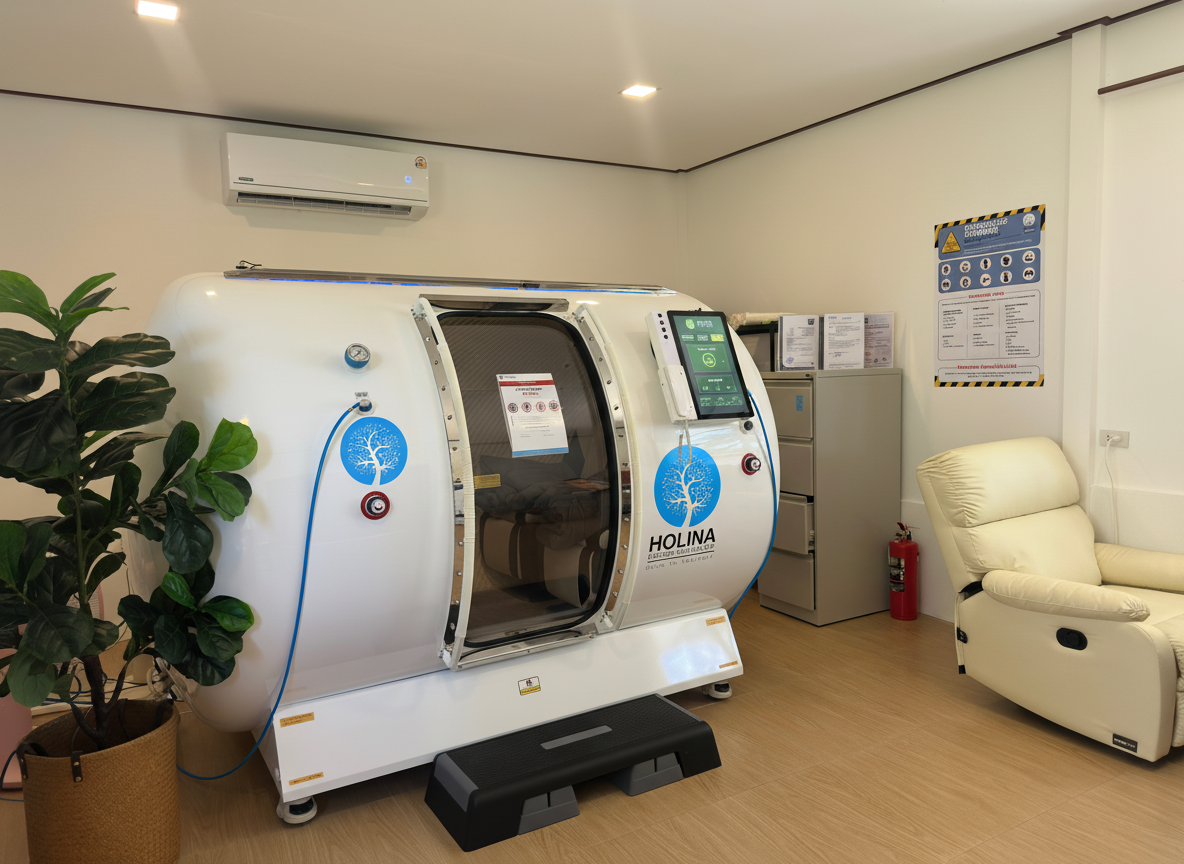
A residential setting removes competing demands and creates the conditions for rapid assessment and change. Comprehensive metabolic, vascular, sleep, and cognitive evaluation occurs across days, not scattered appointments over months. The results inform personalised optimisation across cardiovascular fitness, sleep architecture, metabolic health, neuroinflammatory markers, stress response, and cognitive reserve. HBOT at Holina Clinic represents one modality within a broader framework addressing cerebral perfusion. Supervised implementation of aerobic training, sleep optimisation, dietary refinement, and cognitive challenge occurs within a controlled environment. The residential model consolidates learning and establishes habits before the person returns to previous contexts. This approach produces measurable changes in cognitive function, brain imaging, and biomarkers that substantially exceed outpatient intervention.
For those recognising subtle cognitive shifts in their 40s, particularly high-performing professionals where cognitive clarity is instrumental, Holina Clinic’s integrated cognitive optimisation programme provides the assessment depth and implementation intensity required to meaningfully alter trajectory during this critical window.